
Anyone who’s spent a Saturday at Snowden Grove Park during tournament season knows exactly what Southaven’s energy looks like on camera — seventeen baseball fields running at once, families camped out under pop-up tents, the constant hum of announcements over the loudspeaker, kids in uniform running between games and the concession stand. It’s the kind of scene that practically films itself, and it’s a pretty good window into why video content performs the way it does for businesses in this particular city.
Southaven isn’t a quiet, static suburb. It’s a place defined by motion and events — youth sports tournaments that draw teams from across the country, concerts at a 14,000-seat amphitheater that’s hosted everyone from Willie Nelson to Miranda Lambert, a genuinely active community calendar built around Springfest and the ongoing growth of Silo Square. That kind of visible, ongoing activity gives local businesses an unusually rich well of authentic video content to draw from — most of them just aren’t using it.
Why Southaven’s Culture Is Built for This
A huge share of Southaven’s population is connected in some way to the youth sports economy that’s grown up around Snowden Grove — as parents, coaches, sponsors, or simply neighbors who show up to watch. That shared experience creates a kind of built-in community language that video content can tap into far more effectively than static images or plain text ever could. A quick video of a local business’s team sponsoring a tournament, or a behind-the-scenes look at a business getting ready for a big weekend of visiting families, connects with that shared culture in a way generic promotional content simply doesn’t.
The same goes for the amphitheater and the broader events calendar. Southaven residents are used to consuming their city through events and experiences, not just static information. Businesses that show up in that same visual, experience-driven language — rather than relying purely on text-heavy posts or plain product photography — tend to feel like a more natural fit for how this community already engages with its own city.
What This Looks Like in Practice
Behind-the-Scenes Content That Feels Real, Not Produced
Southaven audiences respond well to video that feels genuinely unpolished and real — a quick walkthrough of a business preparing for a big weekend, an honest look at a process customers don’t normally see, real staff talking about their work rather than reading from a script. This mirrors the same authenticity preference we see across the broader Memphis metro, but it’s especially pronounced in Southaven given how much of the community’s shared identity is built around genuine, in-person, event-driven experience rather than anything polished or corporate.
Content Tied to the Local Events Calendar
Video built around Southaven’s actual community calendar — Springfest, tournament weekends at Snowden Grove, concerts at the amphitheater — tends to outperform generic content precisely because it taps into something the audience is already emotionally invested in. A business doesn’t need to be an official sponsor of these events to create content that acknowledges and connects to them genuinely; it just needs to show up as part of the community conversation rather than standing outside of it.
Customer Testimonials Shot On-Site
Written testimonials are useful, but video testimonials tend to carry significantly more weight, especially in a community-driven market like Southaven where personal trust matters. A short, genuine video of a real customer talking about their experience, shot in the actual business location, does more to build credibility with a prospective customer than pages of written reviews, simply because it’s harder to fake and easier to connect with emotionally.
Simple Explainer and Process Videos
For service-based businesses in particular, short videos explaining what to expect from a service, what a process actually looks like, or answering a common customer question directly on camera tend to perform well and build trust before a customer ever makes contact. This is especially effective in Southaven’s growing retail and service sector, where a lot of the population is relatively new to the area and doesn’t yet have an established relationship with local businesses to fall back on.
Why Most Southaven Businesses Aren’t Doing This Yet
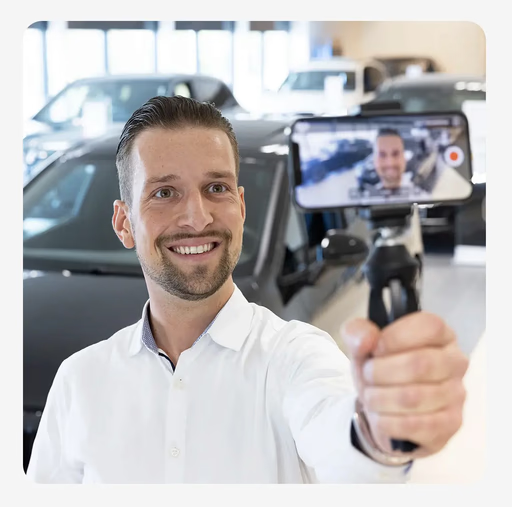
Video content has a reputation for being complicated and expensive to produce well, and that reputation keeps a lot of small business owners from ever attempting it, even though the actual barrier to entry is lower than most people assume. A short, honest, well-lit video shot on a modern phone often performs better than an overly polished, corporate-feeling production, particularly in a market like Southaven that responds so strongly to authenticity over polish.
The bigger obstacle tends to be simply not having a system in place — no consistent plan for what to film, when, or how it fits into the broader marketing strategy. That’s usually where the real opportunity gets left on the table.
Building Video Into the Full Strategy
For most Southaven clients, video content works best when it’s built into a broader, coordinated approach that includes:
- Videography and content creation planned around the local events calendar and real business moments, not generic stock scenarios
- Social media management and advertising, since video consistently outperforms static content in both organic reach and paid ad performance on most major platforms
- Google Business Profile management, where video and photo content posted regularly signals an active, engaged business to both Google’s algorithm and prospective customers browsing the profile
- Website design, incorporating video content directly onto key pages to build trust and improve time-on-page, both of which factor into how search engines evaluate a site’s overall quality
A Local Understanding That Actually Shapes the Content
Glass House Strategies is based in Memphis, close enough to Southaven to genuinely understand the community’s rhythm — the tournament weekends, the amphitheater’s concert calendar, the ongoing growth around Silo Square and the Snowden District. That understanding shapes what we actually recommend filming and when, rather than applying a generic content calendar built for a completely different kind of market.
Founder Caleb Barlow built the agency around honest, transparent client communication, which extends into how video and content work gets planned and reported. Clients get a clear explanation of why specific content is being created and how it connects back to the broader strategy, not just a stack of finished videos with no context about what they’re actually meant to accomplish.
What This Means for a Southaven Business
If your current marketing leans entirely on static photos and text, you’re likely missing one of the strongest natural advantages this specific market offers. Southaven’s culture is built around visible, shared, in-person experience — and video is simply the most effective way to translate that energy into something that shows up in a customer’s feed, builds trust before they ever walk through your door, and reflects the same authentic, community-driven identity this city has built for itself over the last two decades of explosive growth.